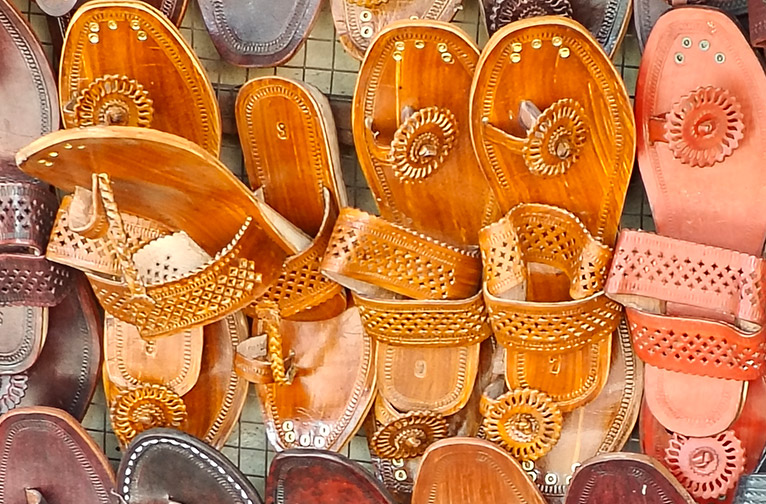
India’s fashion world was aghast, when Maharashtra’s very own Kolhapuri chappals were being flaunted on an international catwalk in Milan, during Prada’s showcase of its spring/summer collection in June 2025. What incensed discerning Indians collectively was that the hand-stitched leather sandal with a distinctive interlaced toe strap worn by the male models was definitely a copy of our Kolhapuri chappals; marked for their unique identity since the 12th century the Kolhapuri chappals on showcase were never acknowledged as the original source to the public. This is not the first time that attempts have been made to appropriate our cultural heritage with equanimity. This exploitation of our crafts and lack of recognition of our artisans for commercial gains is something which will never sit well with us…or for that matter, any other country as well. The fierce protection of their ancestral traditions brings its own share of stories of struggle and exploitation for artisans … which never comes easy.
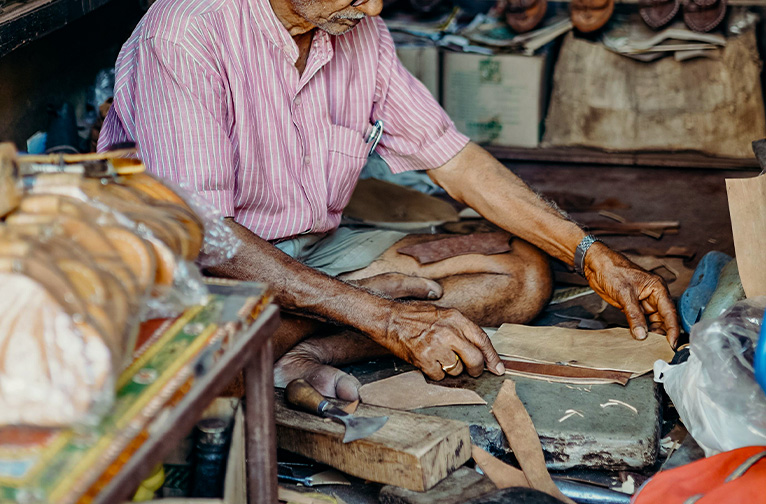
Geographical Indications (GI) tags have come to play an important role as a protective measure to counter these unfair activities. The GI tag, for those not in the know, is a form of intellectual property rights that protect and promote unique products that are connected to specific geographical regions and traditional knowledge. It is also a certification that ensures a product’s authenticity in terms of its regional characteristics and quality.
Did you know that a GI certification is conferred to protect the identity of a craft allowing its use to only those who have earned that right? If imitation products proliferate the market, the value of original craft becomes diluted and loses its identity as a craft sourced out of a unique geographical area. Also, it serves as a highly important way to protect artisans and their rights and preserve traditional crafting legacies.
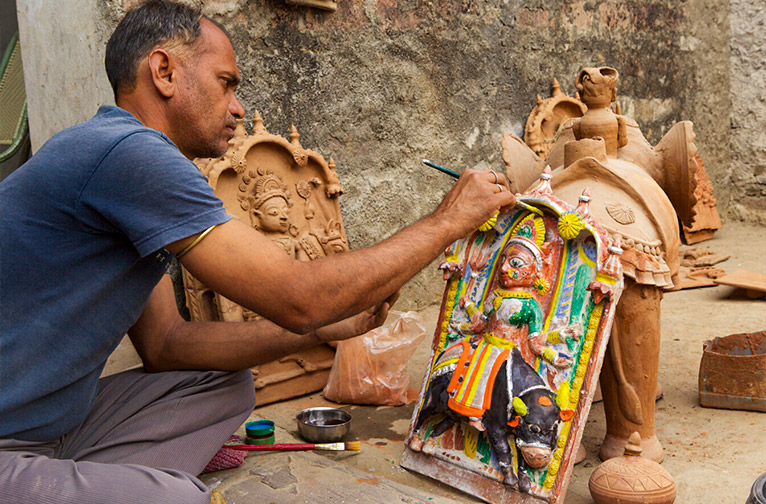
Rajasthan’s iconic footwear, the Jodhpuri Mojari, backed by an artisanal legacy of Rajasthan’s Jingar community for over two centuries, has also been given the GI tag. Also on your travels around Rajasthan, you can shop for GI tagged crafts such as the stunning handworked Thewa Jewellery as well as artworks, Molela Clay pottery items, Sanganeri and Bagru hand block print textiles.
Let’s take a look at the state of Uttar Pradesh, home to the internationally renowned Taj Mahal in Agra. The glamorous Mughal-era mausoleum in white marble has long been recognized for its exquisite craftsmanship. The state has been closely linked to several crafts which have earned the precious GI tag that safeguards their heritage; amongst these are Lucknow’s Chikankari and Zardozi work, Varanasi’s Brocade and sarees, as also its Gulabi (pink) Meenakari Jewellery; Varanasi also has the GI tag for its Soft Stone Cut (Jali) work, its Glass Beads (exported for centuries to the west) Wooden Lacquerware and Toys and Metal Repousse Craft. Kannauj’s attars and Agra’s dhurries too are protected by the GI tag.
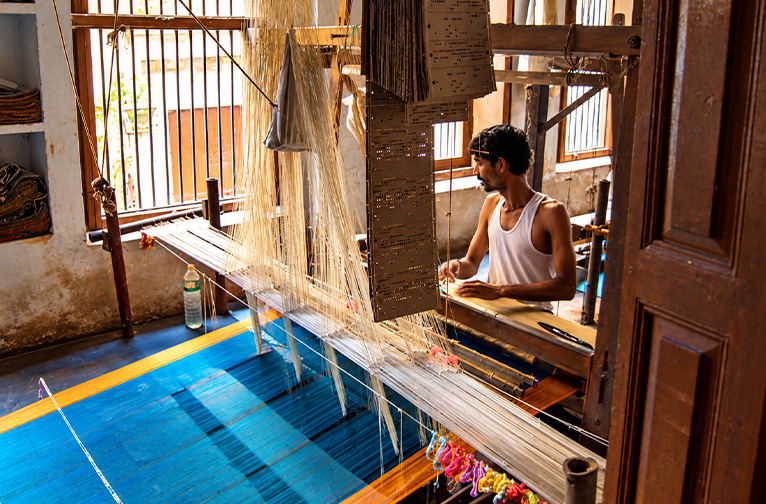
If you are in Varanasi, do make it a point to explore the Madanpura and Alaipura areas where the weavers, with the aid of the pit loom, have been producing the most gorgeous Brocade work (kinkhab) in silk and gold for centuries. Several versions of this splendid craft are depicted as Zari (richly decorated with gold wire work), Amru (decorated with silk thread only, such as the Tanchoi Brocade) and Abrawans (transparent cloth made of silk and organza, such as the Tarbana). Did you know that the oldest and only pure zari workshop in the world is located in Varanasi?
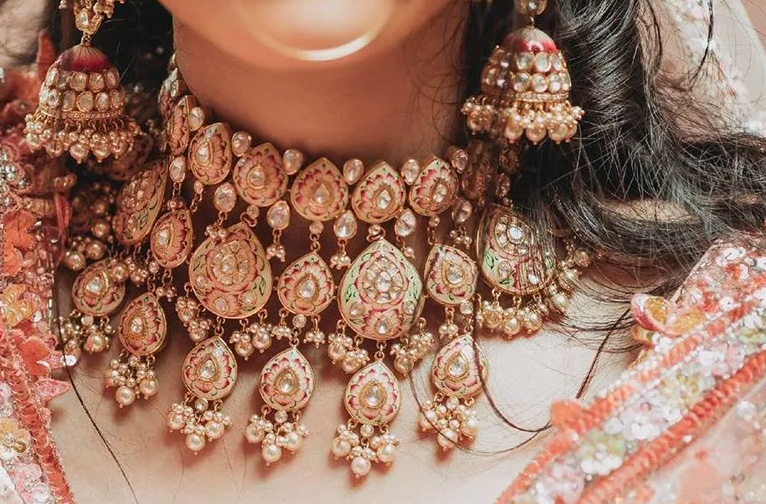
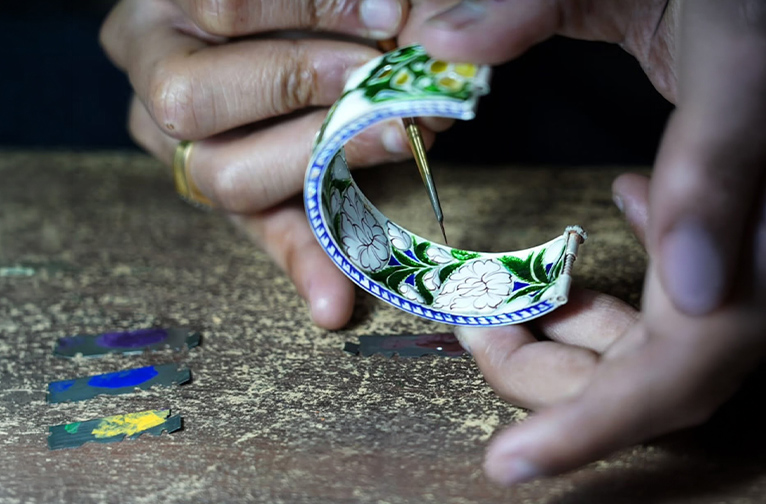
Varanasi’s gulabi meenakari, largely now on a silver base, is an exquisite addition to any woman’s wardrobe. Introduced by the Mughals, it is recognised by its distinctive pink strokes showcased on white enamel; in contrast, Rajasthan’s “Pink City” of Jaipur is famous for its red meenakari work. You can spend hours exploring the skinny lanes of Varanasi’s Gai Ghat to watch the minakars plying their skills in their workshops here. Varanasi’s Metal Repousse craft is a specialisation of the Kasera community who make traditional ornaments, doors, wall decorations, and utensils of precious metals.
Did you know that in Goa, its popular local brew Feni has a GI tag, as does its Khola Chilli? As you can see from this, the GI tag is not a safeguard of the traditional knowledge of crafts alone… it extends to a wide spectrum of products, including unique agricultural products, foodstuffs, wines, spirits, handicrafts, and industrial products as well. In Calcutta, stock up on GI tagged Darjeeling tea, and handcrafted items like a Purulia Chau Mask, the famous Nakshi Kantha and Baluchari sarees.
If you are travelling around Karnataka in southern India, look for the GI tag accorded to the famous Mysore Silk, Kasuti Embroidery, Molakalmuru Sarees Handicraft, Sandur Lambani Embroidery, Kinhal Toys, Mysore Sandal Soap, Mysore Agarbathi, as well as the unique Monsooned Malabar Robusta Coffee and Monsooned Malabar Arabica Coffee, worth picking up for friends and family back home. In Kerala do pick up the beautiful GI-tagged handcrafted Aranmula Kannadi mirrors.
In Chennai, state capital of Tamil Nadu, buy the fabulous Kancheepuram Silk, Thanjavur Paintings, Toda Embroidery, Mahabalipuram Stone Sculpture, Thirubuvanam Silk Sarees, and Dindigul Locks— all of which carry the GI tag. In Pondicherry pick up the much-cherished Villianur Terracotta items and Tirukanur Papier Mache work.
Next time you are creating your wish list for shopping in India, do add some GI tagged goodies to it. Not only will it ensure that you’ll pick up authentic products from the country’s diverse regional geographies, you'll also be playing an important role in helping preserve ancestral artisanal legacies and supporting some of India’s fast dwindling crafting traditions and the humble artisans behind them.